

As the launch of Exclusion Zone Botanist: Epsilon approaches, I’ll be posting regular updates with a behind-the-scenes look at the design decisions going into the game:
Epsilon Update 01: Epsilon overview and launch dates
Epsilon Update 02: Plant features
Epsilon Update 03: Plant morphology
Epsilon Update 04: Exclusion Zone map
Epsilon Update 05: Character creation
Note that everything here is in development and subject to change. These updates are a snapshot of how things looked when they were written.
Follow the Kickstarter pre-launch page to be notified when it goes live!
Public playtesting

As I mentioned last week, I recently attended the Unpub Festival in Baltimore. I was on the Publisher Diaries Panel, ran playtests of Ratsail (“Turtchester”), and did the first public tests of Exclusion Zone Botanist: Epsilon.
The Epsilon testing was done as part of the TTRPG Speed Dating event hosted by 9th Level Games. There were 10 different designers in one of the convention rooms, each one set up at a table with a different game. Attendees came in and cycled through each of the games (1 player per table), spending about 15-20 minutes before moving onto the next table.1
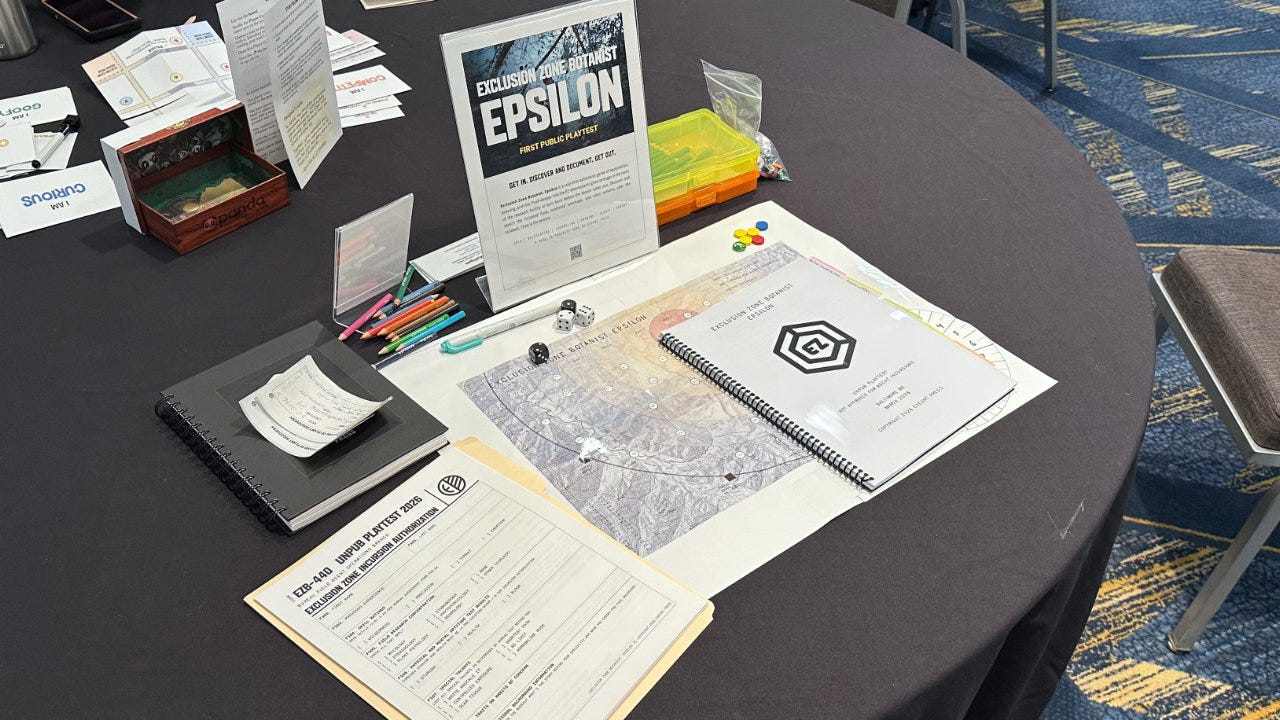
This meant that we only had time for character creation, objectives, and exploring just one or two locations (nodes) on the map. Document one plant and maybe try out a challenge. Just enough to get a taste of the game.
The short version is that the testing went really well. The core game concept and game loop are solid. That was great to hear and confirms that the finish line (i.e. launching the Kickstarter) is in sight.
Feedback summary
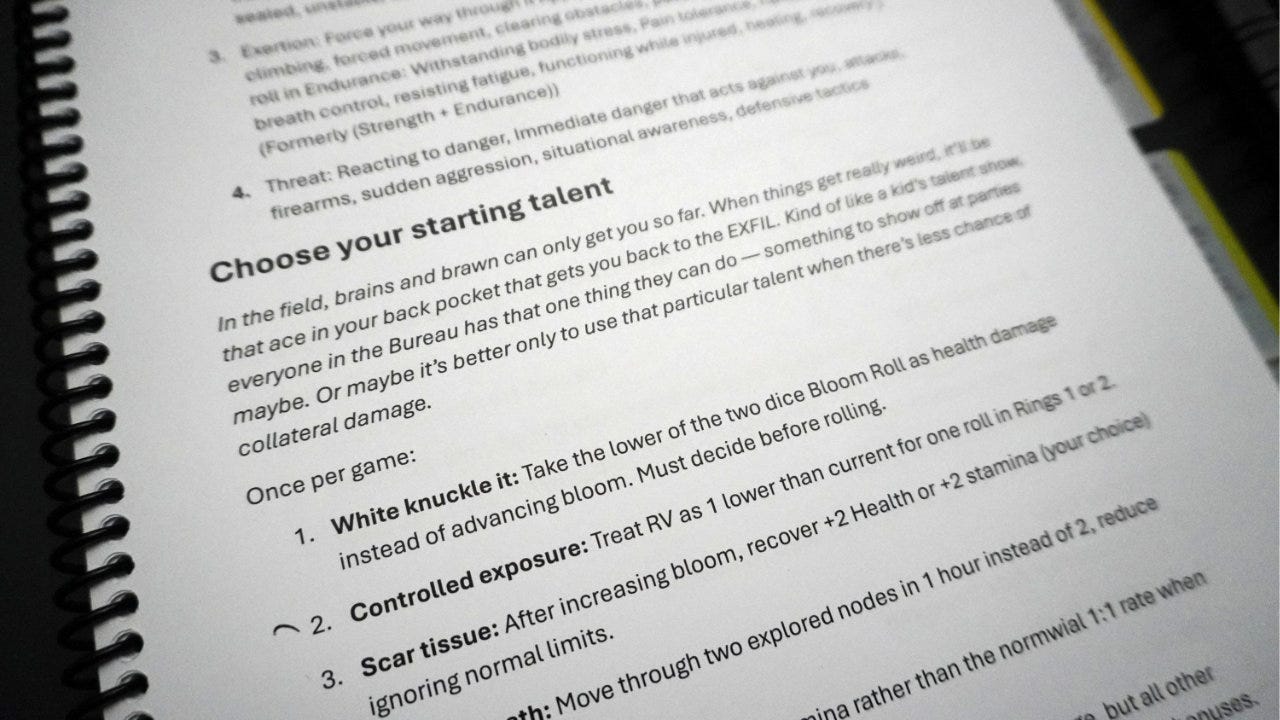
I’d like to go over some of the key takeaways from the testing — not in verbatim detail, but focused on the high level concepts. These are the things that were either reported by multiple playtesters or stood out to me as important things to capture.2
In no particular order including strength (+), opportunity (-), and unsure (?) feedback:
Character creation
(+) Players enjoyed the enhanced character creation and felt that it was the right amount of detail. It was easy to perform but provided a lot of narrative hooks that could be used when journaling. Although I didn’t have it fully implemented, they liked the idea of having a quirk (bad habit) in addition to the other skills.
(+) People felt attached to the character backgrounds and were able to immediately use them to guide how their character would respond to the environment. The mixture of Field Ecologist, Lab Tech, Tactical Response, Academic, Bureau Station Supervisor, and Medic seem to cover a wide enough range.
(+) The four skill system seemed to work well, even though I had accidentally used inconsistent terms in the playtest materials. The skills are currently called Wilderness, Precision, Exertion, and Threat but that is after many changes. Precision was Presence and Exertion and Endurance previously. I’ll need to finalize those and make sure no mistakes make it into the final copy.
(+) I was curious how players would feel about the specialty (e.g. mycologist, ethnobotanist, phytotoxicologist) not having any mechanical impact in the game, but it was appreciated.
Objectives
(+) The addition of primary, secondary, and tertiary objectives was a hit. Selecting an entry portal, planning a route, and moving around the map was reported as being one of the best parts of the game. I’m thrilled to hear this because it’s one of the most significant changes from the original Exclusion Zone Botanist.
(+) The secondary objective list feels right. It’s Bureau tasks (e.g. check the status of an environmental sensor array) and personal missions (e.g. find your lost partner). I feel good about the mix.
(-) Currently, when a secondary objective location is reached, the player is presented with a description and a series of journaling questions. We talked about how the objective should result in a challenge (i.e. dice roll), something discovered, and something gained. I agree with this and plan to implement it.
Equipment and inventory
(-) The inventory and equipment system needs to be trimmed. Too many ways to gain items and no way to lose items. Players didn’t love having to search through a long list of items to see if they applied to the current challenge. I’ll probably reduce it to just 3-5 items.
(-) Based on watching how players interacted with each part of the game, the equipment wasn’t as engaging as the exploration and drawing. Makes sense.
Plant discovery
(+) The new plant discovery system worked well, and players said they appreciated the high-level classification that now begins the process. That works and will remain part of game.
(-) While players we OK with the dice rolling, a few did report that they felt it was at the maximum amount they’d prefer — meaning it’s good, but don’t add anything else. I appreciate that feedback and it remains one of my concerns about the design. I’m hoping to figure out a way to streamline the discovery process if possible. Nothing major, but some small tweaks would go a long way.
(-) I didn’t have the plant reference drawings in the playtest materials (e.g. leaf shapes, leaf arrangements, etc.) and that was a miss on my part. I underestimated how much players rely on those when drawing the plants. I now realize how critical those are for effective gameplay.
(?) To make the drawing easier for the playtest, I made little stickers that could be filled out like a form and attached to the drawings. While it was just for the test, players really liked those. Perhaps having a “form” to fill out for plants might be worthwhile.
Extended play
(+) I already had plans to add a light “campaign system” to the game, meaning you could run the same character through the EZ multiple times. Players asked for this, so it will definitely be included.
(+) Rules for dropping equipment and leaving a mark on the game when a character dies are in the works. Players want to be able to do a corpse run.
(-) Some players want explicit “How did I do?” guidelines when completing an incursion: Is hitting the Primary Objective enough? Do I still get a good rating if I missed the Tertiary Objectives? This makes sense, but I need to ponder how to implement it in an engaging way.
General feedback and thoughts
(+) People loved the theme and setting — especially the new backstory of the Western Exclusion Zone!
(+) The core game loop was easy to understand. I only had to explain it once and people were up and running.
(+) The challenge system works well and probably won’t see any significant changes. I’ll do a full post on how that works, but it’s a simple 2d6 system vs. a target number. I’m tentatively calling it SHX and plan to use it in other Exeunt Press games too, not just Epsilon.
(?) The test manuscript was a dump of everything into US Letter 8.5x11” with minimal formatting, zero layout, and no art. Even so, it was 88 pages. I’m concerned about the page count when converted to A5 5.83x8.27” with art and layout. The goal is to keep it under 200 pages.
(?) The manuscript was spiral bound because it was a cheap way to print it, but people loved it. Got a lot of feedback that they’d like the final to be thematic and look like a field manual. While I’m committed to the book being perfect-bound (i.e. a book with a normal, printed spine), it is an interesting idea. Could the top reward tier include a small spiral-bound reference?
What to keep and what to change?
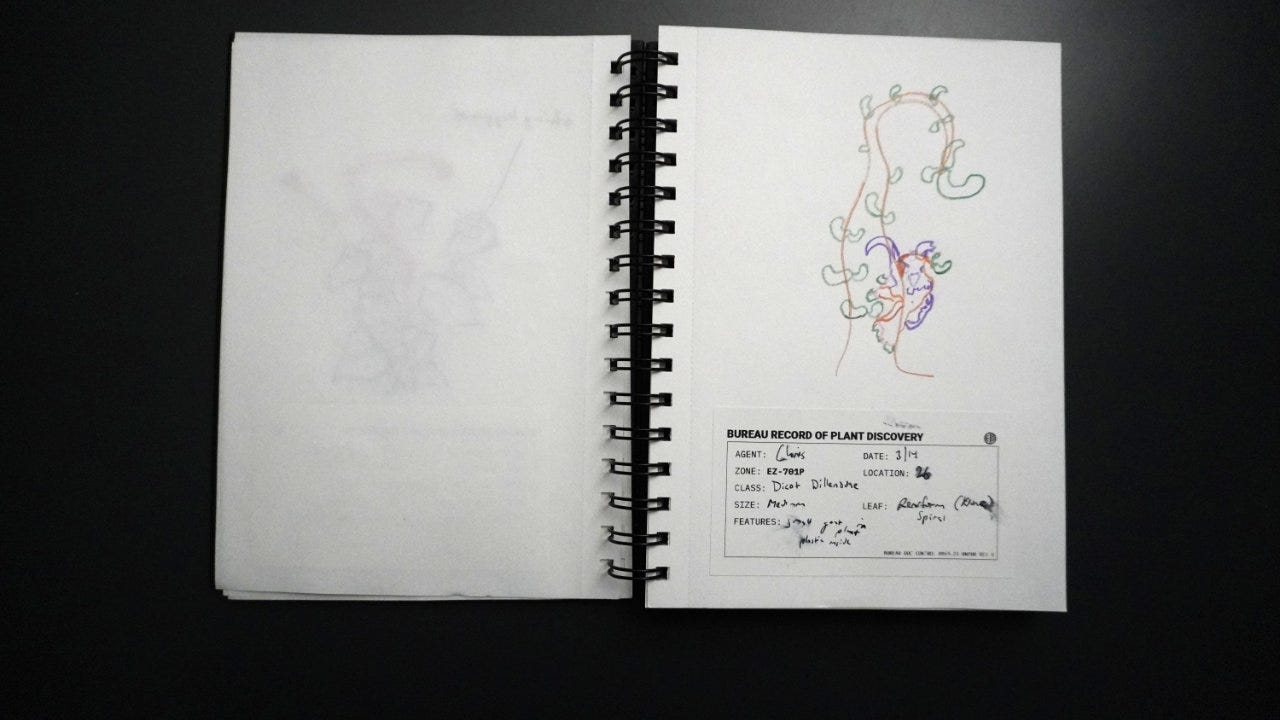
One thing came through loud and clear: Don’t change the setting, tone, drawing, map navigation, or challenge system. Those seemed like the strongest parts of the design that need the least amount of revision.
Instead the inventory will get a tweak and the plant discovery may be tightened up. I’ll make sure the objectives have enough cognitive closure and that rules exist for extended play.3
Again, I’m thrilled that the core game is solid, the content is engaging, and the remaining work merely tweaks the existing structure!
Follow the Epsilon project
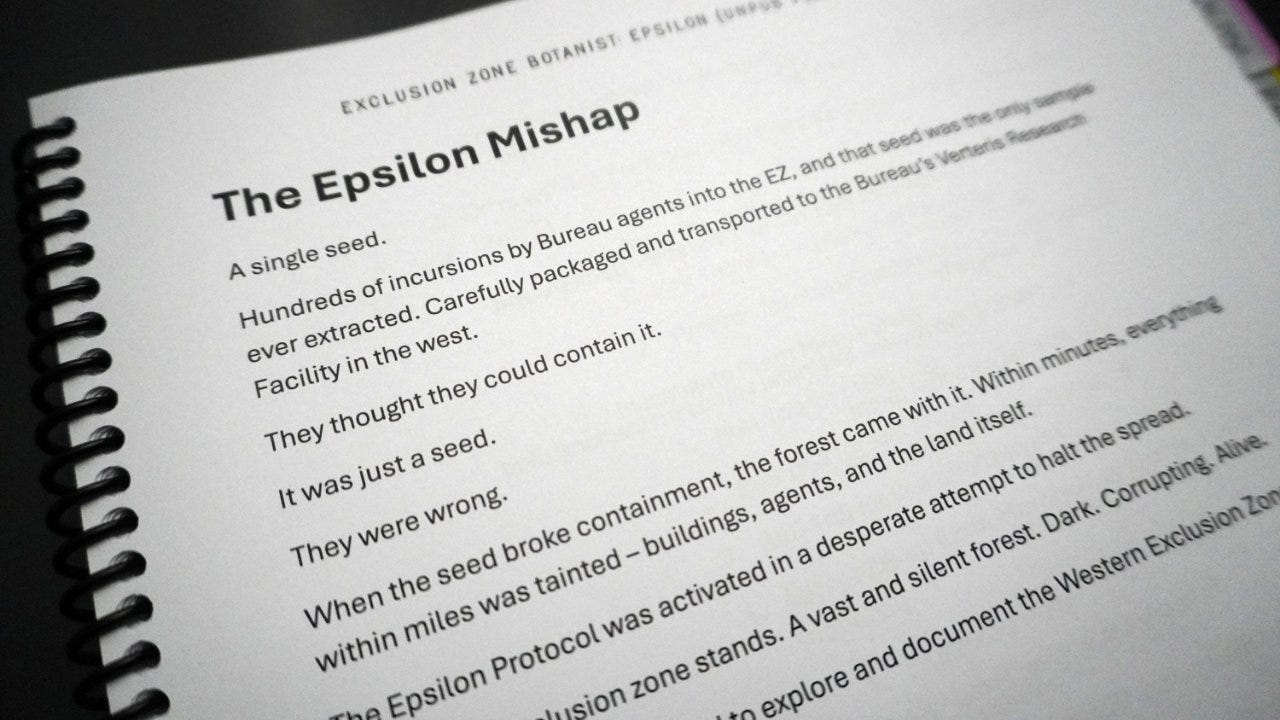
I am posting an Epsilon update on the third Friday of every month through development, launch, and fulfillment. You can read previous updates in the Exeunt Omnes archive.
- E.P. 💀
🌿 Join 900+ other field agents and follow the pre-launch page on Kickstarter to be notified when it goes live. Get in. Discover and document. Get out. 🌿
Play some weird and wonderful games at shop.exeunt.press.
Written, augmented, purged, and published by Exeunt Press. No part of this publication may be reproduced in any form without permission. Exeunt Omnes is Copyright 2025 Exeunt Press. For comments, questions, reports from the EZ, or pro tips: games@exeunt.press
I was able to get additional testing done outside of the TTRPG Speed Dating event in the open testing area. That was extremely helpful as we weren’t under as much of a time crunch to get the game tested and feedback collected.
This isn’t all of the feedback by any means. My actual feedback notes are much longer and include many small details that I don’t think worth repeating here.
I wrote about cognitive closure at length in the garbage time article (May 2025) at Skeleton Code Machine. It’s a complicated topic, especially when applied to games.
fwiw, the thing that hooked me first and made me purchase Exclusion Zone Botanist was seeing the plant reference drawings in the product preview images. That scientific look and flavor was huge, and I am generally put off by drawing games that don’t provide any visual hints of what the player’s drawings might look like. Anyway, I’m a huge EZB fan and am super stoked about Epsilon!
I do love a spiral/coil bound gaming book. It's so much easier to use and I'm less afraid of hurting it. I have a couple hardcovers that I won't use because they won't lie flat, so I use the PDF instead even though I prefer using a physical book. Softcovers are a little easier, usually, and I sometimes clip them open if they won't lie flat. We actually bought a coil binder so we can turn any game PDF into a coil bound book, though we usually only do that with shorter game books.
I'm glad playtesting went well and you got useful feedback! The poll at the end is cruel, only letting us choose one thing. At this moment, I'm most interested about character creation. At another moment it'll be the hexcrawl. Or challenges.