
As the launch of Exclusion Zone Botanist: Epsilon approaches, I will be posting regular updates. It’s a chance for you to get a behind-the-scenes look at some of the design decisions and work going into the game.
Follow the Kickstarter pre-launch page to be notified when it goes live!
If you’d like to know what Epsilon is and when it will launch, see the October update.
Everything (including Epsilon) is pointcrawl!

Back in December, working on Epsilon got me thinking about hexcrawls, pointcrawls, and the differences between the two. That turned into a 2,519 word article called Everything is Pointcrawl that’s turned out to be quite popular and sparked quite a bit of conversation about maps.1 If you haven’t read that post yet, I recommend you do. Today’s update will make a lot more sense with that context in mind.
After much consideration of the original Exclusion Zone Botanist hexcrawl map and how objectives impact routing, my conclusion was this: Given a hex map of sufficient size but with almost no pre-defined points of interest on it, a rational player with limited in-game time and resources will take the shortest path from their starting location to the goal.
For a relatively small game like Exclusion Zone Botanist, that’s not a problem. Players wander into the EZ and if they head back out the same way they came in, no big deal.
But with Epsilon, I wanted something deeper — where decisions about which way to go next really mattered.
Transforming the EZ from hexcrawl to pointcrawl
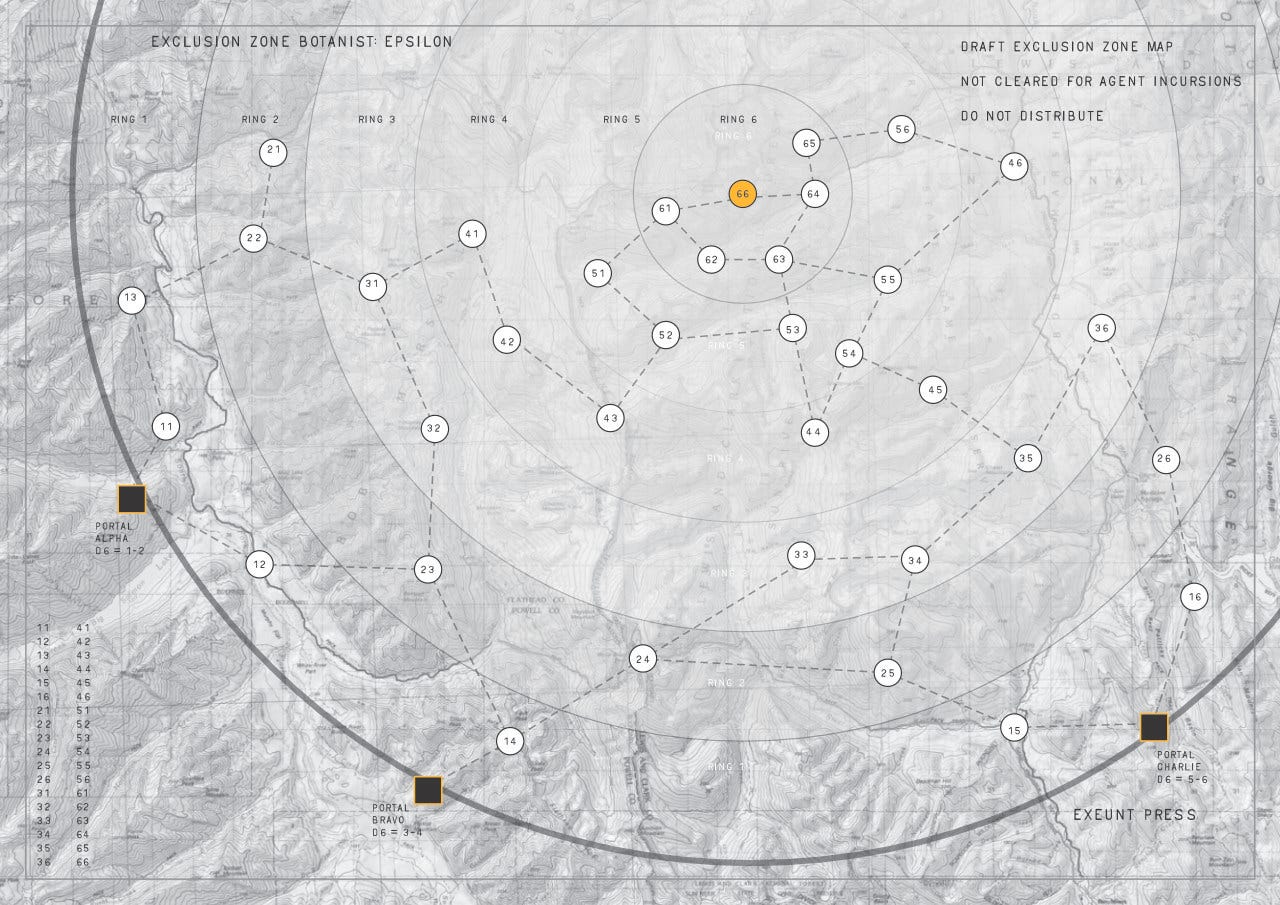
The new map of Western Exclusion Zone 701-E for Epsilon will explicitly be a pointcrawl, and I’m really excited about it! You can see the proof of concept version I’ve been using for testing in the image above. Please note that it’s not even close to final, and art/layout hasn’t even begun yet.
It solves a few key design challenges for Epsilon.
1. Multiple competing, positional objectives
The high-level objective for Epsilon is the same as Exclusion Zone Botanist: Get in. Discover and document the flora. Get out.
But now the map is arranged in six concentric circles (Rings 1 - 6) centered on the remains of the Bureau’s Verteris Research Facility (VRF) with increasing levels of corruption, mutation, and risk:
Ring 1: Basically normal
Ring 2: A little strange, uncanny, not dangerous
Ring 3: Very strange, unsettling, horrific, not dangerous
Ring 4: Extremely strange, mildly dangerous
Ring 5: Horrifying and very dangerous
Ring 6: Impossible, reality-breaking, potentially lethal
A network of 36 location nodes is overlaid on this map, allowing for exploration across all six rings. It’s always about 9-11 hops to get from a starting portal to the central node of Ring 6, but the paths to get there differ.
This matters because in addition to the Primary Objective (i.e. “Discover and document Ring 6”), the player will have a personal Secondary Objective with a randomized location in one of the six rings. This objective location might be the last known location of your Bureau partner before the incident or an environmental sensor array containing important records.
Additionally, the player will have three Tertiary Objectives — recovery of aerial drop probes deployed at the time of the incident and spread across the zone.2
Before the game even begins, the player will have at least five objectives marked on the map, some more important that others. The Primary Objective is the one mandated by the Bureau, but the Secondary Objective might mean more to your character. It’s unlikely that you’ll be able to complete them all and get out alive.
This immediately makes even a decision such as selecting the entry portal matter. It also means that going in and out the exact same way will rarely be the optimal path.
2. Multiple entry and exit points
In Epsilon, there are three infil/exfil portals rather than just one. Thematically, this is the Bureau’s increased knowledge of how the zones work. They can open and maintain three portals, but only one at a time… and even then they are unreliable.
Before entry into the EZ, your agent has time on their side. They can wait for the optimal portal to open up and start their incursion. Getting back out isn’t as easy.
I’ve added a system that changes the active portal every X hours spent in the EZ. This adds one more layer of unpredictability. You can’t count on getting back out the way you came in. Instead its up to the clock and a bit of luck. The key is knowing that once the portal changes, you know where it will be for a while. Make your move then — not right before it changes.
3. Paths and routes matter
Combining multiple paths on a pointcrawl map, multiple competing objectives, and variability in entry/exit points means player routes matter in Epsilon. It leans into the push-your-luck core of the game and the inability to accomplish everything in a single incursion.
Everything is a multiple of six

A while ago, I was discussing game design with M. Allen Hall and he gave me a helpful piece of advice: “Make everything a multiple of six.”
He meant that in a game where I’ve decided to only use six-sided dice (d6), there’s an inherent advantage to making everything else a multiple of six.
For example, by having three portals, I can easily have the player roll to see which one is the active portal (Alpha: 1-2, Bravo: 3-4, Charlie, 5-6). With 36 nodes arranged with six nodes in each ring, players can easily roll for a location across the entire map by treating it like a D66 random table. Or I can have rolls that are restricted to a single ring by fixing the first of the two digits. There will be six character backgrounds and six secondary objectives. Each zone will have 18 unique plant features. The plant morphology system will have 12 major classifications.
I think I’ve instinctively done this before, but I hadn’t previously thought about it as an explicit design rule.
It’s a good piece of advice, and one I’ll be following as Epsilon development continues.
Follow the Epsilon project

I am posting an Epsilon update on the third Friday of every month through development, launch, and fulfillment. You can read previous updates here:
Epsilon Update 01: Epsilon overview and launch dates
Epsilon Update 02: Plant features and encounters
Epsilon Update 03: Plant morphology and classification
In future updates, I’ll talk more about character backgrounds, objectives, and encounters.
🌿 Join 800+ other field agents and follow the pre-launch page on Kickstarter.
- E.P. 💀
P.S. If you love tabletop games, you should check out Tumulus. It’s a print-only, quarterly zine packed with Skeleton Code Machine game design content.
Play some weird and wonderful games at shop.exeunt.press.
Written, augmented, purged, and published by Exeunt Press. No part of this publication may be reproduced in any form without permission. Exeunt Omnes is Copyright 2025 Exeunt Press. For comments, questions, reports from the EZ, or pro tips: games@exeunt.press
If you wanted to submit that article to The Bloggies, that would be much appreciated! The submission deadline is January 31, 2026.
I wanted the probes to be roughly the size and shape of a Yeti 26 oz. Rambler water bottle, but as made by Apiary Heavy Industries: “Apiary Heavy Industries High-Altitude Ground-Recovered (HAGR) ‘HoneyDrop’ Drop Probes: The HAGR HoneyDrop is a compact, single-use atmospheric sampling probe designed to be released from unmanned aerial vehicles (UAV) and recovered intact on the ground. Each unit is 27 cm long and 9 cm in diameter with a hexagonal cross-section, approximately the size of a large insulated water bottle.”
If I don't make it out of the EZ, someone please come find my field notes, at least! Just... beware whatever my hubris ignored.
“Make everything a multiple of six.”
As far as I can see (but I am no mathematician), you are right that working with six-sided dice, your “probability buckets” (chances of landing in any group of cells of a d66, d666, etc) will be multiples of powers of 1/6, but why does that mean that the number of distinct game outcomes has to be a multiple of 6? (Or of a factor of 6 greater than 1 — i.e. 2 or 3.)
You can arbitrarily assign your 36 cells of a d66 table to any number of game outcomes ≤ 36, but expect lumps or spikes when the division is against you. Or you can map your 6 die outcomes to fewer than 6 rows or columns and produce distributions reminiscent of the digital filter artifact graphs one used to see in hi-fi magazines.
For example, group the 3s and 4s together for this spiky d55 (25 “cells”):
<https://anydice.com/program/41614>
output 1d{1,2,3,3,4,5}+1d{10,20,30,30,40,50} named "spiky d55"
Of course, I don’t mean to knock the idea of doing everything in twos, threes, and sixes. A choice made is future choices avoided! ;)