
I’ve survived one of the busiest week’s I’ve had in quite a while: frantically trying to get two games ready for testing, four days at Unpub Festival 2026, and then rolling right into teaching a 2-3 hour workshop at Harrisburg University. And yet I’m also creatively energized, full of new ideas, and eager to get back to game design work.
For today, I want to give a quick update. Each of these topics will be covered in detail in the future. Expect to hear more about the Epsilon playtest on the next update on the third Friday of each month. My learnings from Unpub and the HU workshop will eventually turn into Skeleton Code Machine articles.
But for now, here’s the short version.
Playtest: Epsilon
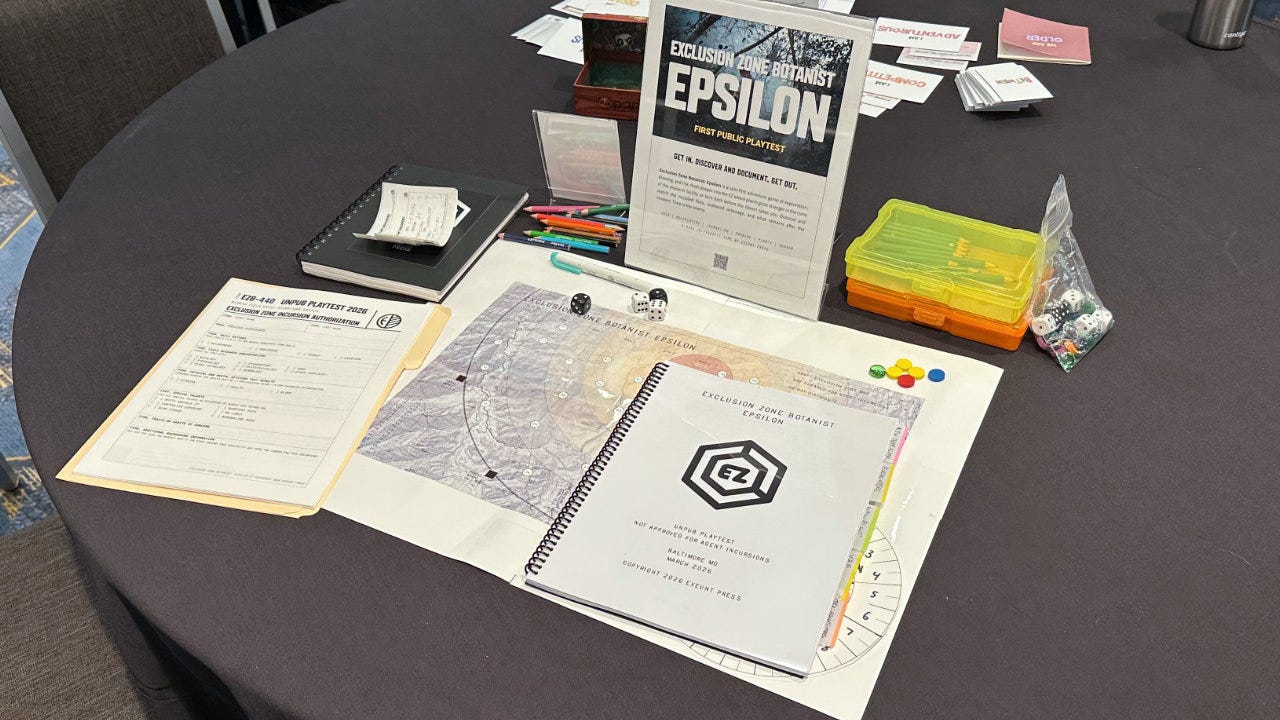
I was invited by 9th Level Games to be part of their TTRPG Speed Dating event on Thursday evening. They had about 10 different designers set up at tables in one of the event rooms, of which I was one of them.1 As attendees came in, they were distributed to open tables (1 player per table) to give the games a try for 10-15 minutes before rotating to the next table.
While I had some worries about how I would playtest a solo game, it all worked out fine. We were able to complete three tests during the speed dating event and one extra test the following day, all of which provided extremely valuable feedback. It’s all currently scribbled in the book I had printed for the test, but will soon be organized and moved to my actual notebooks.
At a high level, the feedback was extremely positive and confirmed that Exclusion Zone Botanist: Epsilon is nearing completion. I don’t expect any major system changes or rewrites. There are smaller issues of balance and streamlining that I’ll handle over the coming weeks. Overall, I’m really encouraged and feel like I can finally see the finish line on this project!
I’ll continue to post Epsilon updates on the third Friday of each month.
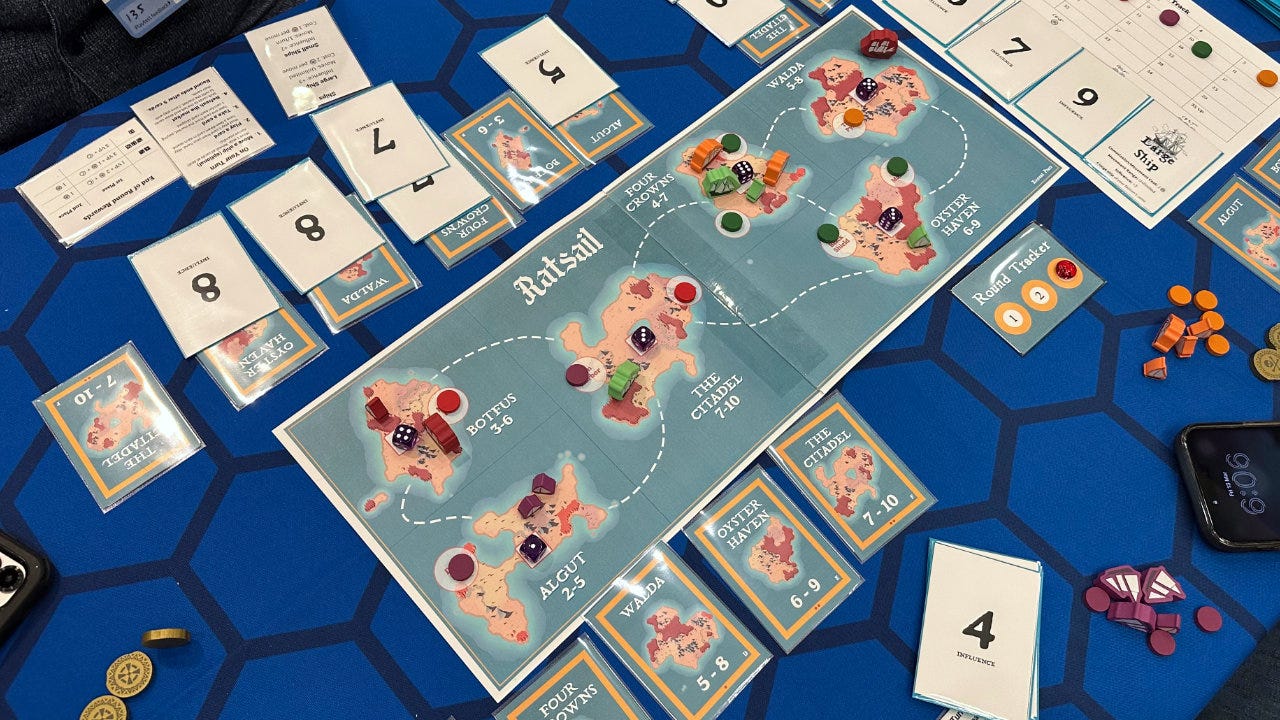
Playtest: Ratsail / Turtchester
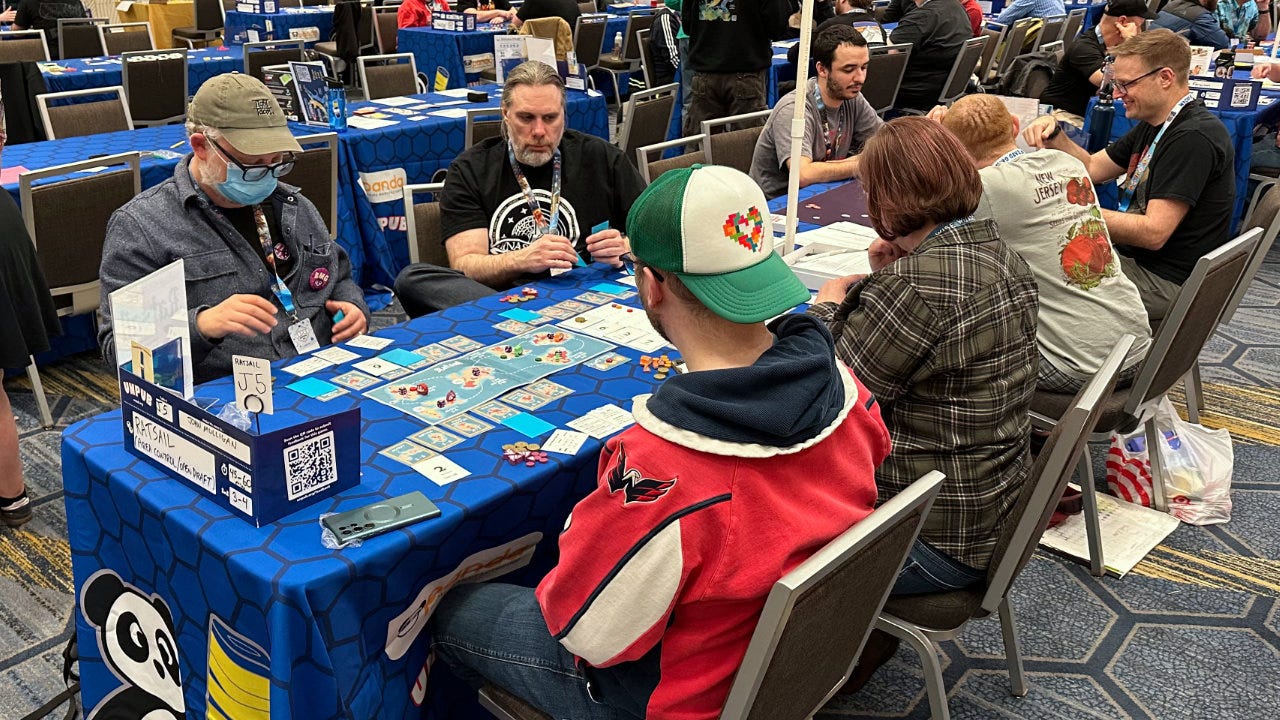
I’m happy to report that my first public playtest of my first board game design was a success. I was able to get two plays in during my single registered Unpub playtesting block, and then two other plays outside of that — for a total of four plays.2
Absolutely wild to see people playing the game without me!
As with Epsilon above, I have mountains of notes and scribbles to go through and formally process into feedback and actions. That said, I have a few gut reaction takeaways:
The core game is solid: Across the board, players reported that they enjoyed the game and felt the core gameplay was good. Almost all feedback focused on what they called minor revisions: how many cards should be hidden at a time, how much a ship should cost, the coin to VP ratio, and so on.
The teach was easy: People picked up the game without a problem. The first round was a little slower, but by the second round people were taking fast turns: move a ship, play a card, take a card. Keeping the complexity at about a BGG 2.50 or less is a key design criteria for this one.
The theme was good: Although I’m not personally tied to the theme, the last minute theme switch from “generic fantasy city with nobles” to “anthropomorphic rats who sail ships” was well received. The theme might change again, but I’m happy with this latest switch.
It still needs some work: We hit a problematic game state (for a single player) during the first playtest. Luckily it was easily solved and I could apply a “hotfix” in all subsequent games without reprinting anything. The market was clogged with ships at least twice, but not in a game-breaking way. These are all solvable issues and I have more than enough ideas on what to try next.
Again, it’s really exciting to know I made a working board game that people have fun playing. I think the next step is to figure out how to get it on a platform like Screentop to allow for online testing.
Workshop: Maps as data structures
Greg Loring-Albright, Ph.D. (Ahoy, Keep the Faith) invited me to run a map workshop for his game design class at Harrisburg University (HU). The topic was “Making better maps by thinking about them as graphs and data” which was based on the Everything is Pointcrawl post at Skeleton Code Machine.
I tried to make it very hands-on, with each of the four sections including some exercises that involved drawing or modifying maps. We started with making maps of our neighborhoods from memory, practiced converting maps to graphs, learned ways to improve game maps (e.g. loops), and ended with making five room dungeons with a boss monster.
The students were highly engaged, knowledgeable about game design, and asked really good questions. Some of their examples were better than the ones I had given, so I’ll be revising the slides based on what they shared. Made for a really fun and inspiring day.
I’ll either have one long post about the workshop contents here at Exeunt Omnes or perhaps turn it into a more technical multi-part series at Skeleton Code Machine. I’m curious which would you prefer?
Exhausted but inspired
If you’ve ever been to a game convention, you know the feeling. You come home exhausted and ready to collapse, but at the same time your head is spinning with new ideas. That’s where I’m at right now — and it’s wonderful.
Thanks for reading. I might go take a nap.
- E.P. 💀
P.S. If you love tabletop games, you should check out Tumulus. It’s a print-only, quarterly zine packed with Skeleton Code Machine game design content.
Play some weird and wonderful games at shop.exeunt.press.
Written, augmented, purged, and published by Exeunt Press. No part of this publication may be reproduced in any form without permission. Exeunt Omnes is Copyright 2025 Exeunt Press. For comments, questions, reports from the EZ, or pro tips: games@exeunt.press
I was one of the designers, not one of the tables.
Technically we didn’t get time to finish one of the plays because the block ended, but we did get 2 of the 3 rounds complete with scoring. I feel confident that we had captured the key parts of feedback for that session.
Maps. One cannot have enough maps!
Huzzah for inspiring exhaustion! Also I love that the students gave you ideas for updating your slides. Yay for two-way learning!
If the poll were multi-choice, I would have selected both multiple post series and zine, but assuming the series would be in the lead, I went with zine. I think this topic would make a nice zine alongside the making a one page RPG zine.