
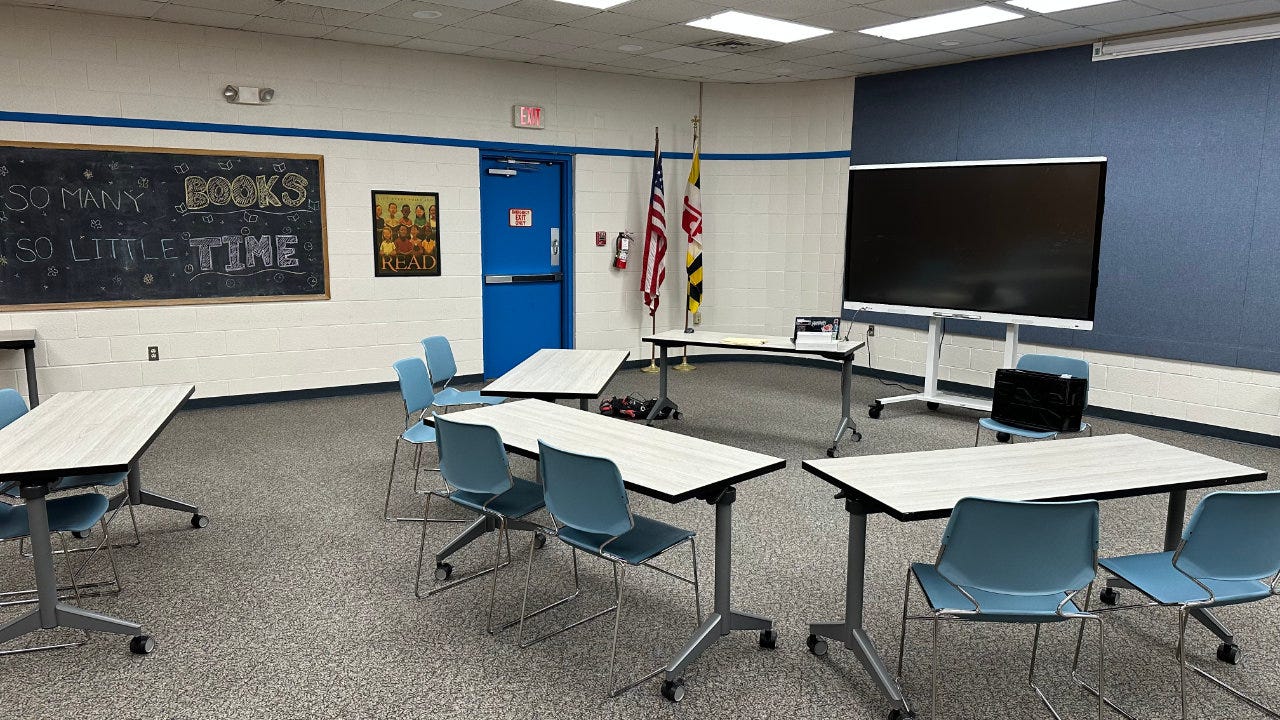
I ran a free public library tabletop game design workshop recently just outside of Baltimore. It went really well. Not only was it well attended with all the seats full, but everyone was so enthusiastic and engaged!
The structure was exactly the same as the hands-on workshop I ran at the Gettysburg Library back in January, which was based on the crash course I taught at Dickinson College.1 So I’m comfortable with the material, how participants react to the various activities, and what to expect.
While it works really well, I can’t help but try to think of ways to improve it going forward. Can we make the output (i.e. a playable game) the focus of the class from the first slide?
What did I cover in the recent class?
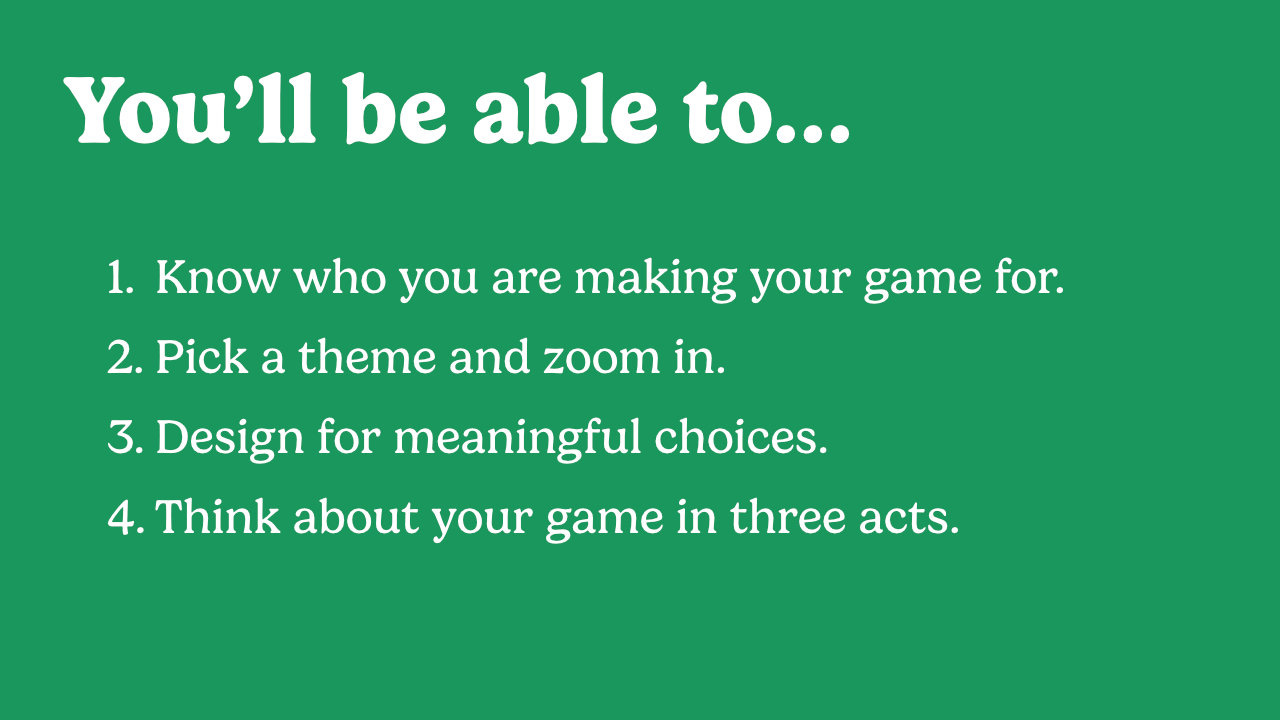
My goal for the 2-hour public library workshop is to have participants walk away with four new skills:
Know who your game is for: Understanding the kinds of fun you want your players to have and what kind of players would enjoy your game is fundamental to design. We cover the 8 Kinds of Fun, Bartle’s Taxonomy, and the Quantic Gamer Motivations along with some easy exercises.
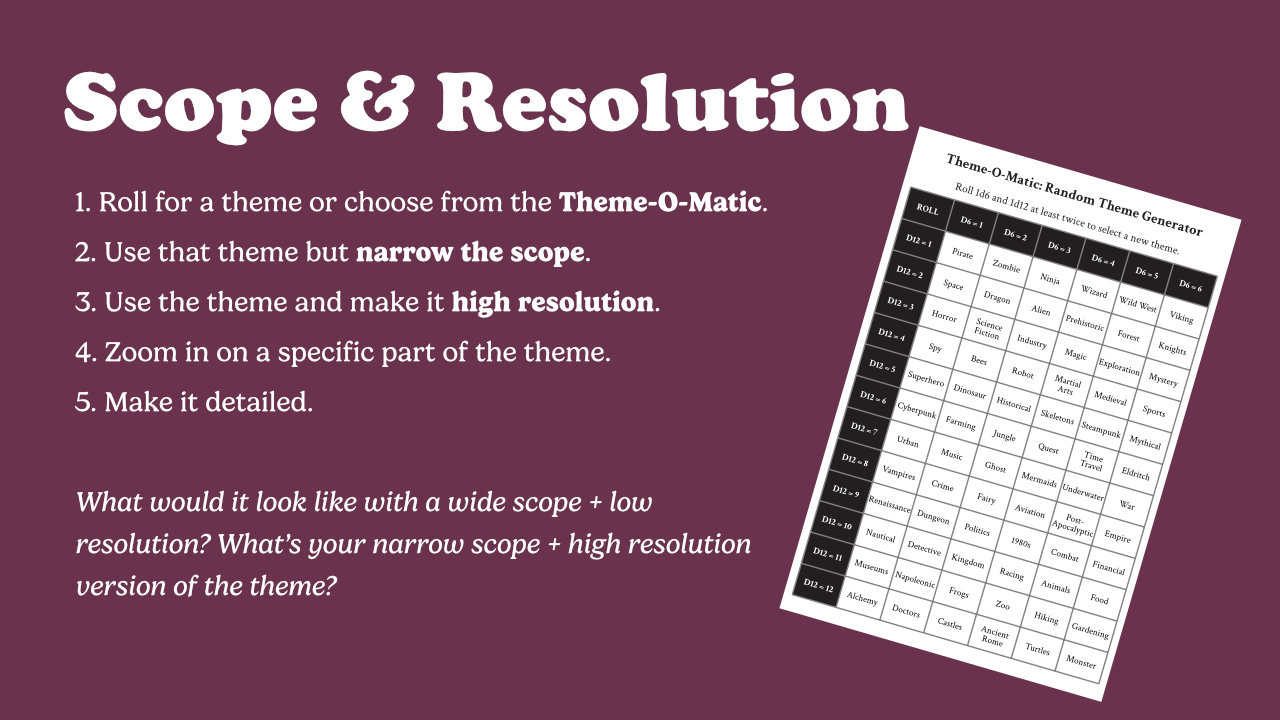
Be able to pick a theme: Relying heavily on Sarah Shipp’s work on thematic game design, we pick random themes (e.g. mermaid pirates) and try to narrow the scope and increase the resolution — zooming in.2
Design for meaningful choices: We cover player agency models, what it means to give players a choice, and how to avoid false choices.
Think about your game in three acts: The final concept is how to make the beginning of you game feel different from the end of your game using Freytag’s Pyramid. We also talk about how to make sure your game ends.
At the end of those four sections, the participants have a very simple game that uses their selected theme. It’s not a good game (by design!) but it’s enough to imagine what it might be in the future. We then take turns pitching our games using a standard format.
There’s usually a few minutes at the end for discussion and questions.
What changes would I make in the future?
I spent some time pondering the questions above, particularly about cutting out some content. It’s a lot to cover in just two hours. I’d really like to have more time for discussion and working on games.
Here are the changes I’d probably make to future classes:
Reduce the types of players section: The way it is now, we spend time on not only LeBlanc’s 8 Kinds of Fun and Bartle’s Taxonomy but also the Quantic Gamer Motivations. While I like the emphasis on how different models can be used to answer the question of “Who am I making this game for?” it is probably too much. The Quantic stuff is definitely getting cut. Bartle’s might be cut too. The 8 Kinds of Fun does everything I need to cover.
Reduce or cut the game arc section: I’m torn on this one because participants find game arcs and timers interesting, but it takes a lot of time to explain. Cutting it allows the class to focus on just three big ideas versus four. Perhaps I can roll it into the Worst Dungeon Crawl Ever iterative design exercise.
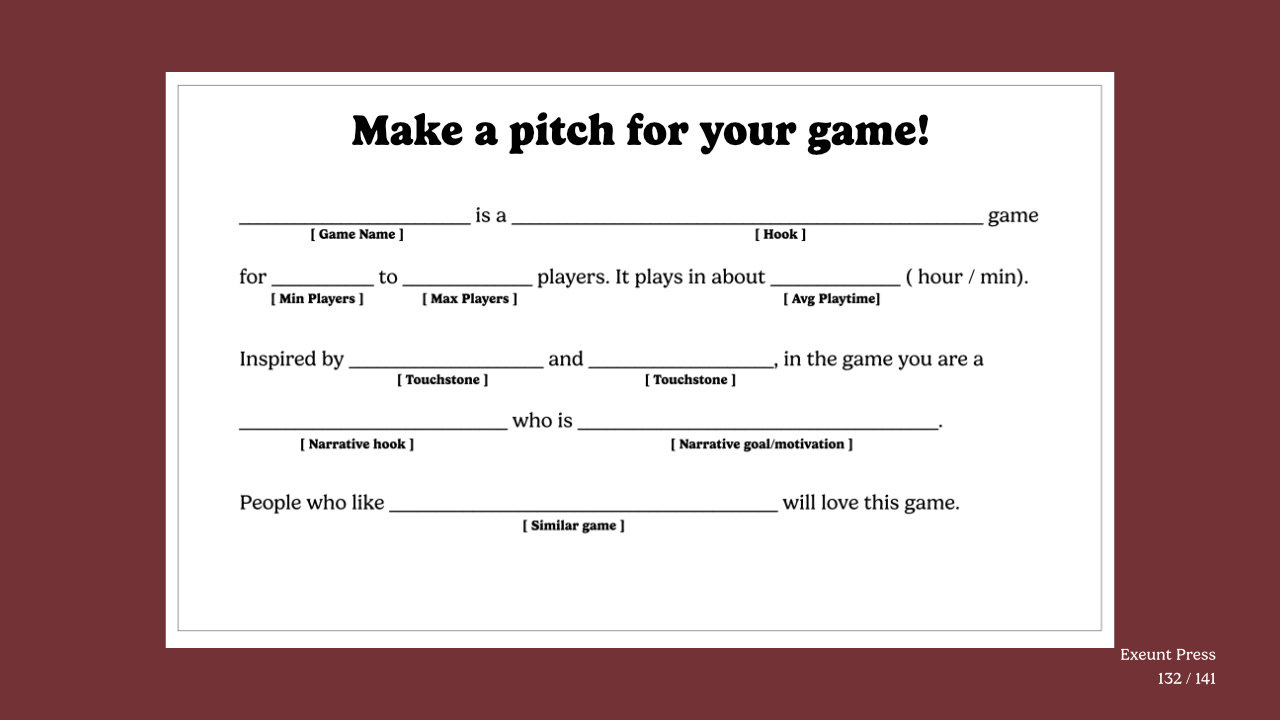
Make the game the goal: During the class we choose themes and each participant makes an intentionally bad card-based dungeon crawl game with it. Then we use iterative design and player agency models to make it better. We usually end with everyone doing a Mad Libs style pitch of what they’d want their game to become. It’s fun, but it’s crammed in the second half of the class. Perhaps I can restructure to make this game the overarching goal from the start.
Keep but restructure the kinds of games: I spend some time covering the differences between types of games: board game vs. TTRPG, euro vs. ameritrash, high luck vs. low luck, abstract vs. thematic, party vs. reflective. It’s helpful to include, but it can be tightened up. Is it possible to combine this into the 8 Kinds of Fun?
Incorporate map-making: I ran a map-making workshop at Harrisburg University recently based on Everything is Pointcrawl. It went over so well, I wonder if there are elements of that 3-hour class that could be incorporated into the 2-hour free library classes. Probably not enough time, but worth considering.
Allow more time for pitching: The game pitches at the end are always fun and energizing but they are also the last activity before time runs out. So while they are great, they also feel rushed. I’d like to use some time picked up from above to give more time to pitches.
There are some other small changes to slides and structure that I’d do, but these are the big ones that I’m considering.
Focus on the output
I think my biggest conceptual change is to move away (a little bit) from the focus on four specific design skills and focus the workshop on the output — the games.
It might be possible to pitch the class as “make a board game in 2 hours” and have that be the structure, but ensure that we hit the design skills along the way. The class would progress in the same order (e.g. the kinds of fun is first), but we’d be working on our games from the start.
This might allow us to fill out our pitch sheets as we go so that reading them out at the end is the culmination of our work.
Continual improvement
I really think the class structure is good as it is right now. I’ve heard nothing but positive comments from those who have participated. I’d be happy to run it again without any changes.
And yet, I can’t help but think about how it could be tweaked and improved.
Iterative design and playtesting. It’s not just for games. ;)
Let me know in the comments what you think of the proposed changes!
- E.P. 💀
P.S. If you love tabletop games, you should check out Tumulus. It’s a print-only, quarterly zine packed with Skeleton Code Machine game design content.
Play some weird and wonderful games at shop.exeunt.press.
Written, augmented, purged, and published by Exeunt Press. No part of this publication may be reproduced in any form without permission. Exeunt Omnes is Copyright 2025 Exeunt Press. For comments, questions, reports from the EZ, or pro tips: games@exeunt.press
Check out this How to Run a Tabletop Game Design Workshop at Your Library webinar I ran for the Indiana State Library. I talk about how to use hands-on activities and how to promote the class to the community.
We use the Theme-O-Matic that’s included in Make Your Own One-page RPG to roll for random themes.
When I run game design workshops, I follow basically the same formula with one exception. I talk about mechanics first, because I think that is a big driver of a game's theme and genre as well as who is going to want to play your game. People who want to play a light and fun game aren't going to want a lot of mechanics. Likewise, people who want a gritty dungeon crawl are going to favor systems with more mechanics.
I also tend to talk about mechanics and theme and audience as two separate topics, which I then put together in the design part of the workshop. This is because design is often not a linear process and sometimes you want to design mechanics first and sometimes you get an idea for a theme and genre and the mechanics are 2nd. I want to give people tools for their own game design so that they can develop their own processes.
I do like your Madlibs pitch idea and will add that in as an option for people. I think it will be good for those who are overwhelmed by choices and help them focus in on something they can work with.
Could you please expand on “ increase the scope and resolution” of a theme? (or provide some links for this), it’s where I most need help