
As the launch of Exclusion Zone Botanist: Epsilon approaches, I’ll be posting regular updates with a behind-the-scenes look at the design decisions going into the game:
Epsilon Update 01: Epsilon overview
Epsilon Update 02: Plant features
Epsilon Update 03: Plant morphology
Epsilon Update 04: Exclusion Zone map
Epsilon Update 05: Character creation
Epsilon Update 06: Playtesting
Epsilon Update 07: SHX system
Epsilon Update 08: Bloom
Epsilon Update 09: Inventory
Epsilon Update 10: Timeline
Note that everything here is in development and subject to change. These updates are a snapshot of how things looked when they were written.
Follow the Kickstarter pre-launch page to be notified when it goes live!
Exploration and discovery
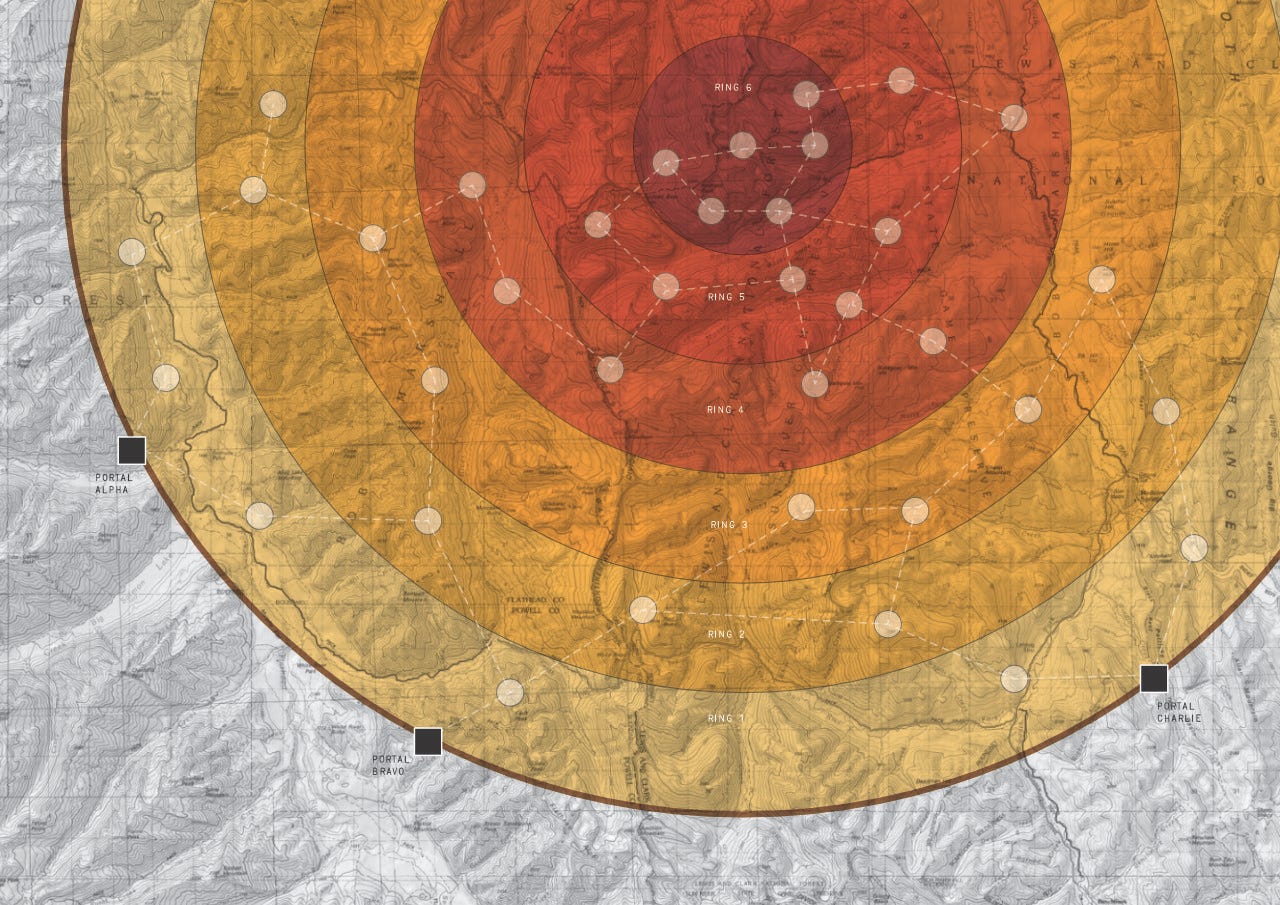
I consider exploration and discovery to be core elements of Exclusion Zone Botanist: Epsilon. I want you to feel like you are walking into the unknown, unsure what you will find, and surprised by what is there.
One way to do this is to move to a larger, pointcrawl map as I described in Epsilon Update No. 4. Combined with primary, secondary, and tertiary objective locations defined on the map, this creates interesting routes and some tough choices.
When you move into a new node, however, you still need a way to find out what’s there. For that, I want a simple die roll system.
Here’s how it works:
When entering an unexplored node, roll 1d6 + Ring, where Ring is the current concentric ring that you are in on the map (ranging from 1-6). This yields a number between 2 and 12, depending on your current location on the map. Higher ring numbers (deeper into the EZ) will produce higher results on average.
Compare the result versus the discovery table:
2-5: Alpha Class encounter
6-9: Plant discovery1
10-12: Beta Class encounter
Make additional rolls as necessary to define the encounter or plant.
Let’s take a look at what each of these results mean.
Three different discovery results
The discovery roll results in one of three outcomes:
Alpha Class encounters are fairly routine and sometimes mundane. They include thick underbrush, annoying insects, strange smells, and unstable terrain. Some are hazardous (and trigger a challenge), a few are strange, but they are rarely unsettling or inexplicable.2 Many of them have associated journaling prompts.
Plant Discoveries are still the core of the game. These result in a new, undocumented plant being found. You’ll roll for plant morphology and features.
Beta Class encounters, on the other hand, are where things get really weird. Strangling roots, incoherent VRF event survivors, crash sites, and truly dangerous things are all in this class.3 Many of them are challenges.
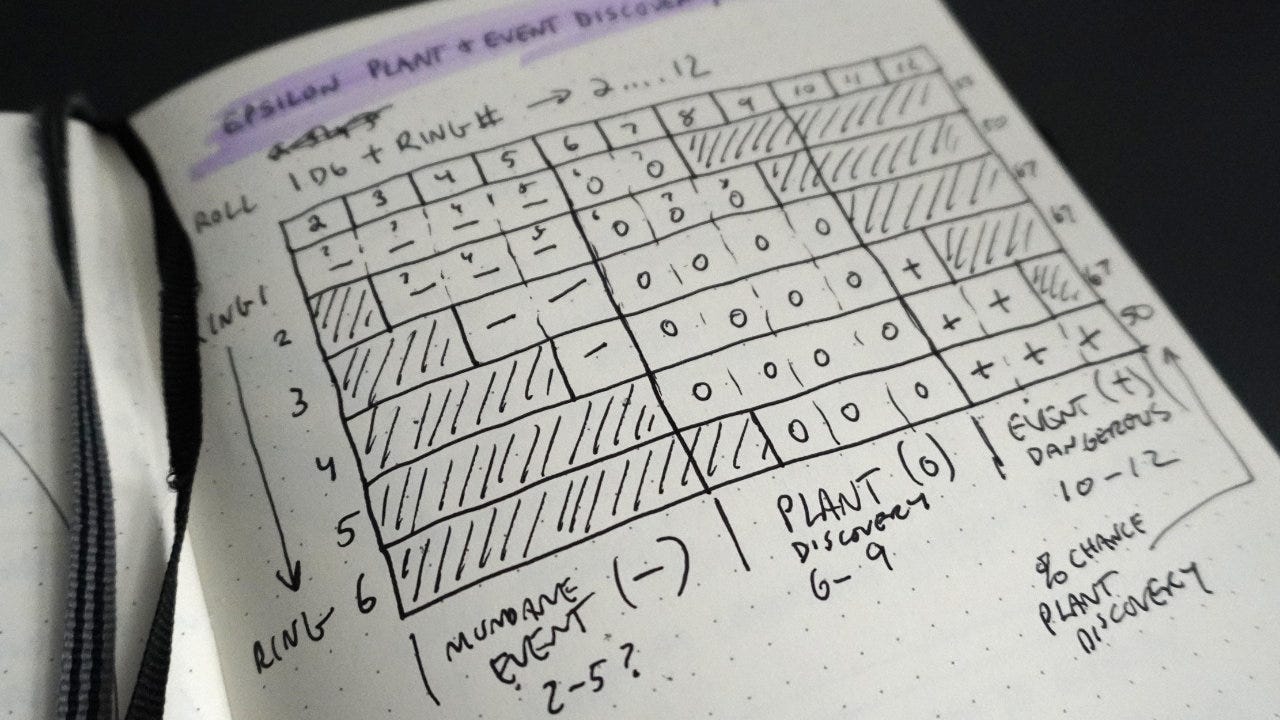
This discovery system has elements of a depth crawl. Moving deeper into the EZ toward Ring 6 at the center shifts the results of each discovery roll. You can see this in the photo of my original, rough notes above.
In Ring 1, the possible results are 2-7. A result of 6 or 7 means a plant discovery. That’s 2 of the 6 possibilities or a 33.3% chance of discovering a plant. You are more likely (66.7%) to have an Alpha Class encounter. There is no risk (0%) of a Beta Class encounter in Ring 1.
You are most likely to discover new plants in Rings 3, 4, and 5 with an approximately 67% chance of finding one. The chance of finding new plants is actually a little bit lower in Ring 6 at 50%.
The more dangerous Beta Class encounters don’t show up until Ring 4 (17%) and increase to a high likelihood in Ring 6 (50%), at the remains of the VRF in the center of the EZ. In Ring 5 and Ring 6, there is no chance of a rather mundane Alpha encounter. It’s either plant discovery or a Beta encounter.
Objectives, risk, rings, and discovery
I like that this creates a natural progression of discoveries as you move deeper into the EZ. Things start pretty normal in Ring 1 and the chance of discovering a new plant is pretty low. Things get more weird and dangerous as you approach your primary objective location at the center in Ring 6.
If you were only tasked with discovering plants, you’d avoid Ring 5 and Ring 6, but the new primary, secondary, and tertiary objectives (each tied to locations on the map) force you into other rings. Suddenly routes matter, time in each ring matters, and taking the shortest route isn’t always the best plan.
That’s the feeling I want in Epsilon: a constant pressure to move, explore, watch the clock, and wonder if you have time to complete one more task before you must leave the EZ.
- E.P. 💀
P.S. Follow Exclusion Zone Botanist: Epsilon on Kickstarter. I post updates here on the third Friday of each month.
Play some weird and wonderful games at shop.exeunt.press.
Written, augmented, purged, and published by Exeunt Press. No part of this publication may be reproduced in any form without permission. Exeunt Omnes is Copyright 2025 Exeunt Press. For comments, questions, reports from the EZ, or pro tips: games@exeunt.press
These ranges aren’t final. Based on playtesting, the 6-9 range feels right for plant discoveries. You might think that it needs to be wider, but 67% chance is 1 in every 3 rolls, and players were really enjoying the encounters.
The Alpha and Beta names began as placeholders as I wrote each encounter. They were meant to be temporary but have since grown on me quite a bit. There’s still a chance they might be renamed in the final game, but there’s an equal chance they remain.
The VRF is the Verteris Research Facility, site of the mishap that created the new Western Exclusion Zone. The Epsilon Protocol was activated in a desperate attempt to halt the spread.
I really appreciate the visual nature of your graph. I find that when I'm toying with the math of oracles behind the scenes, it's hard to conceptualize (math is not where I shine). Your graph, however, makes it all super clear. Don't know why I didn't think to do that before. Thank you for sharing!