

Chances are, if you are reading Exeunt Omnes (this newsletter) you are also a reader of Skeleton Code Machine (the other newsletter).
Today’s topic is one that could almost be a Skeleton Code Machine article, but not quite. It’s more of me thinking through some design ideas rather than a targeted analysis of a game mechanism. It’s one of those topics where I’m not even really sure I know what I think about it, let alone telling others what they should think!
I’d love to hear your thoughts in the comments.
HO HO GO AWAY: As we cross the liminal space between Christmas and New Year’s Day, you might be craving some alone time. If so, the I Need Some Holiday Alone Time solo game sale is running for another day or so. Includes 10 solo games (digital PDF only) with each item 50% off or buy everything for $19.99. Regularly $42.93. Save 53%!
The upkeep phase
I play a lot of board games.
BG Stats shows that, with just one day left in the year, I’ve had 134 plays of 82 different board games in 2025. I had an additional 73 online plays of about 40 different games on Board Game Arena.1
One thing that shows up in many of these games is an upkeep phase.
It could be at the end of a players turn or at the end of the round, but the idea is the same: players take time to refresh hands of cards, refill dynamic markets, move monsters, add more fires, or otherwise update the game state. Sometimes it is simple and takes just a few seconds. Other times, the upkeep phase includes rather involved if-then statements like the Elephant’s March in John Company: Second Edition.2
The key element of an upkeep phase is that it is necessary to enable the game to continue and yet includes almost no player choice or agency.
Player boards are cleared, cards moved, elephants turned, but none of that relies on players deciding what to do next. Even if dice are involved, it is all programmatic and structured. Players simply follow the instructions step by step to complete the phase.
Examples of upkeep in solo games
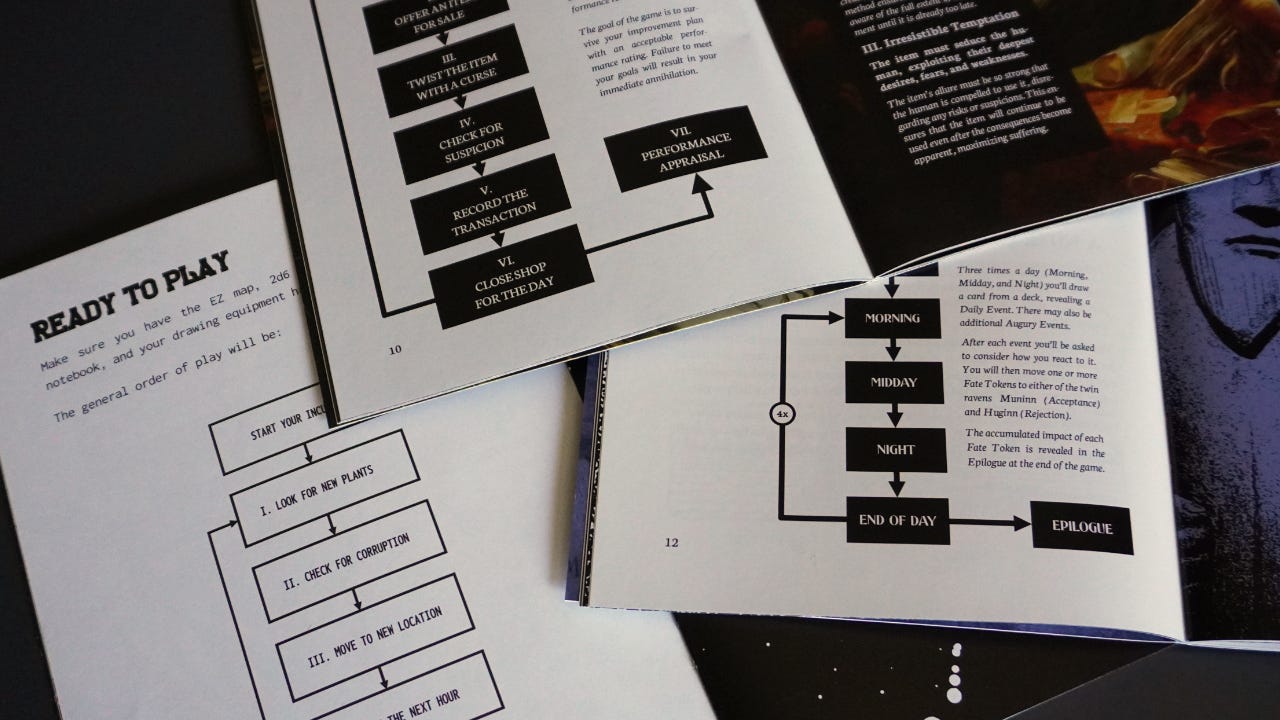
The idea that players take actions and then spend a little time doing upkeep is so common, so normal in board games, that I didn’t think about it much until recently.
Here’s how upkeep shows up in three examples:
You can see it in Exclusion Zone Botanist where after discovering and documenting plants, you roll dice vs. the risk value in Step II. Check for Corruption. It’s not quite as clear cut as some games because you move after the upkeep (vs. before), but it’s the same idea.
Eleventh Beast has a kind of upkeep when rumors are added and the beast is moved, but it comes at the start of the player’s turn rather than the end. I’m not sure why, but this feels less like upkeep at the start vs. end of a turn.
Ghost Beacon (one-page micro edition) has perhaps the most explicit upkeep step. After exploring the planet by taking two actions, the player rolls dice to add geologic faults and then to activate beacons. After this upkeep is complete, they start the next cycle.
They all approach upkeep in different ways, but the core idea is present. There are some low/no agency tasks that must be performed to keep the game running.
Is this upkeep a bad thing? I don’t think it is. The games above are mechanically simple enough that the upkeep takes literal seconds. It’s not a problem. In fact, I quite like the tension of checking for corruption after each hour in Exclusion Zone Botanist!
But what about games that are more complex?
The zero-upkeep game

I’ve started to wonder, “Is it possible to eliminate upkeep phases from games?”
Medusa is a solo space survival-horror game that I’ve had in the Exeunt Press pipeline for a long time.3 My original design idea notes are from March 2021. It’s been cooking for a while, but I recently began working on it again.
The game focuses on crisis management with systems failing on the ship. The original idea included a non-trivial player upkeep phase — as you’d expect in a board game.
While I’d argue the upkeep phase is not inherently bad, I do wonder if I could challenge the assumption that it needs to be there. To that end, I’ve been working to take the tasks from the upkeep phase and either (a) build them into player choices earlier in the game loop or (b) eliminate them from the game.
Especially in a solo game, I like the idea of the player being able to immerse themselves in the narrative without the need to stop the story to update things. If my guess is correct, this will create a more engaging player experience.
Question your design assumptions
An assumption I’ve carried from playing board games into my designs is that games have actions and they have upkeep. It’s a model that works extremely well in board games and works quite well in solo TTRPGs too.
But it is just as important to identify those almost-subconscious assumptions in game design, question if they make sense, and then decide how they fit into the player experience you are trying to craft.
Medusa may very well include an upkeep phase when complete. But if it does, it will be there by conscious design choice and not just by accident.
Have you discovered any design assumptions that you are using? Can you think of other ones that people hold? I’m particularly interested in ones that are not inherently bad, but just the conventional way to do things.
- E.P. 💀
P.S. If you love tabletop games, you should check out Tumulus. It’s a print-only, quarterly zine packed with Skeleton Code Machine game design content.
Play some weird and wonderful games at shop.exeunt.press.
Written, augmented, purged, and published by Exeunt Press. No part of this publication may be reproduced in any form without permission. Exeunt Omnes is Copyright 2025 Exeunt Press. For comments, questions, reports from the EZ, or pro tips: games@exeunt.press
I refuse to track online board game plays the same as in-person plays. Yes, I can import the BGA plays into BG Stats and then just filter them out by location. Yes, the BGA plays are synchronous so we are all “at the table” at the same time like an in-person game. Doesn’t matter. They don’t “count” the same as in-person plays. :)
John Company: Second Edition is one of my top games of all time. My few but memorable plays of it have been some of the best tabletop gaming experiences I’ve ever had. But that Elephant’s March upkeep phase… oof.
Medusa was listed as a game in the pipeline for 2025.
I think upkeep is sort of the natural ebb and flow of events. Sort of baked into life in general right? Even day to day events have rising action, resolution, then falling action. Maintenance and upkeep sort of go hand in hand.
I'm not sure you could eliminate upkeep entirely from a game. Even if it is a simple, you can accomplish X things today, today still ends, the character sleeps. Does the character push on through today into tomorrow? How long can they push it? When do they crash and force even that brief stage of upkeep. Sleep refreshes X number of tasks they can perform. Would the scavenging for resources to power something count as a folded upkeep/exploration loop?
I guess the question more turns to is the upkeep a needed step? What does it add to the game? Is it just a numbers thing? Can it be jazzed up? Does it need to be? Can it be simplified? If it's taken out of the loop, how does that alter the flow and feeling? Is it noticeable? What differentiates Upkeep from Maintenance? Is there one in this case?
I don't know if I'm being pedantic or not, but it's things that I think about and chew on when I'm working on things. My brain likes crunchy, but not overly complicated systems. Like peanut butter. Added layers of texture does wonders for an otherwise boring thing.
Sorry, DM brain really took a hold of this and ran for the trees. It's made me sit back and look at how I run my campaigns and hold them up to the light and really think about it.
I've always viewed upkeep in STTRPGs as a form of world building. For me, they tend to drive immersion rather than detract from it. Almost every story that's not written in the first person has breakaways from the main story that deal with "upkeep" of the world. And even a lot of first person stories still contain that.
Example: any scene that does not explicitly contain Harry Potter in a Harry Potter book could be considered a (factional) upkeep scene. Or Ender Wiggin in Ender's Game. Or Paul in Dune. Or James Holden in the Expanse.
As far as gear upkeep goes, Mad Max Fury Road is rife with gear upkeep scenes. Most horror and survival movies indulge in gear upkeep as a general rule of thumb.
Even outside of factions and gear, emotional upkeep scenes can be said to be the foundations of drama and romance stories. Emotions and morals are constantly reevaluate and re-examined. "Alas, poor Yorick! I knew him, Horatio" is a wonderful example of an emotional upkeep step as a scene.