

Although Exclusion Zone Botanist: Epsilon remains the main project at Exeunt Press this year, I’ve also been working on some other games. This week, I’d like to talk about my learnings from playtesting one of those games: Proxwar Zero.
Two games, both alike in dignity
One of the games is a spiritual successor to You are a Muffin called We are Mushrooms. It takes what I’ve learned since publishing it in 2022 and applies it to the new game’s design. There are more opportunities to personalize your character, a greater variety of prompts, and (what I find most interesting) connections between the random events. The game is made to be played either solo or “solo together” with others. After one more check from my editor, it’ll be ready for a test print.
The other game is a cyberpunk city-builder called Proxwar Zero, based on the Gridlock City game included in Tumulus Issue 01. It’s influenced by world-building games such as Beak, Feather, & Bone by Possible Worlds Games, which was itself influenced by Avery Alder’s The Quiet Year.
I wanted to use my board game knowledge to give the competitive mechanisms more teeth. My goal was to make the core mechanisms of the game solid and enjoyable, even without the storytelling and thematic layers.
Proxwar Zero gives you the feeling of controlling a shadow faction conducting secret operations: funding landmarks, torching rival headquarters, and burning allegiances. Each of the 12 available factions (including both corps and hackers) has an asymmetric Special Op that feels unique. You build and destroy the city, all the while placing bets on which faction will have the most power in the end.1
How it got here contains a valuable lesson in playtesting.
Iteration zero
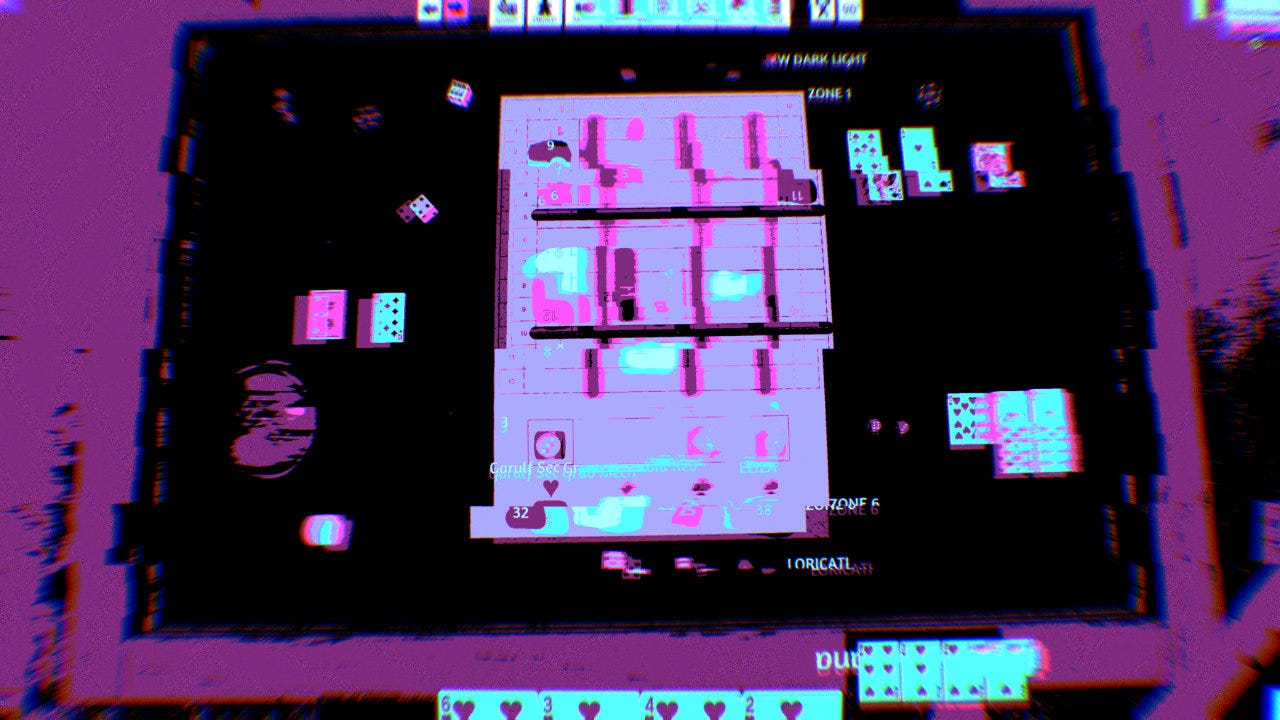
Proxwar Zero is a game where 1-4 players compete by influencing the factions of a cyberpunk city to gain control. Players don’t control anything on the map. They are not the city factions. Instead, the players represent shadow organizations waging a proxy war via the city’s corps and gangs.
I spent a lot of time writing the rules, revising them, and adding mechanisms to counteract potential problems that might arise. The original playtest version of the game rules came in at over 3,900 words.2 There were rules for drafting factions, setting up the map, and preparing starting hands. Players each managed a hand of cards but also a face-down, dynamic stack of cards. Each player’s turn included three phases, each of which had multiple steps and options. The end game had multiple scoring steps and a slew of tiebreakers.
It was different, interesting, complex… and a bit of a mess during the first playtest.
Imagine a beautiful house of cards that eventually collapses under its own weight. That was the first iteration of Proxwar Zero.
There were so many steps that it was a burden to play. Many of the steps required multiple lookups and references, such as cross-referencing the card suit to the faction to a color when drawing it on the map. The map had zones that restricted actions and then dice that restricted the zones. It was system upon system that made it feel like we were fighting the game the whole time.
We did end up finishing, but I could hardly say it was a fun time.
And yet, we agreed there was a great game in there!
More streamlined and more engaging
That first playtest was a fairly discouraging experience. Afterward, I copied the whole mess into a new Notion subpage called “Deprecated” and started over.
I did not, however, throw away all that work. Instead, I tried to write the rules again, but this time from my memory of the playtest. I kept the parts we felt were fun, and ruthlessly ripped out as much complexity as possible. How can I eliminate the need for color coding? Can I just use a single hand of cards? Can I get rid of the dice completely?
I ran another quick, partial playtest and cut some more.
I ended up reducing the rules by almost 50%.
Setup now takes almost no time at all. Turn order and “first player” no longer matter. Players choose a single action on their turn and it moves to the next person. There’s a clear end game trigger and scoring is easy.
Based on the latest partial playtest, Proxwar Zero is, without a doubt, a far better game:
Setup is faster
Turn order is simpler
Actions are streamlined and useful
The storytelling elements have space to shine
Scoring is cleaner
These changes didn’t just mechanically improve the game (though they did). They made the game easier to play. The proxy war aspect of the game and its emergent storytelling come through more clearly now. The game is more engaging because players spend less time navigating procedures and more time creating a cyberpunk city.
The idea of influence vs. control is retained and still central to the game. The covert ops are faster, cleaner, and easier to understand. There’s room for players to become their corp or hacker faction as they play the game.
There is, of course, some design work to do. For example, some of the faction “Special Op” abilities need balancing, I need to check the average game length, and the map needs to be finalized. But that is all to be expected at this early stage of development.
So the question is: Did I waste all that time by writing more and more rules before the first playtest?
Reducing muda
There’s a concept called muda (無駄). I’ve seen it translated as “futility” or “wastefulness”. Muda is more than physical waste and defects. It’s any waste of time, effort, and focus that does not add value to the final product.3
Given my background, I couldn’t help but think of this after the playtests. Did I spend hours of time across days or weeks writing rules for no reason? Should I have stopped sooner and tested earlier?
The answer isn’t an entirely clear one.
I ended up ditching almost half of the entire Proxwar Zero design (as measured by word count).4 It might have been better to incrementally add, rather than design and delete en masse. Designing in this way produced a significant amount of muda.
At the same time, while I could have avoided a lot of the “wasted” design time, I wouldn’t have had so many different ideas in the game to test. It’s because it had everything in it that we found the best parts. I’m not sure the core concept of the game could have been expressed in a minimalist form.
As soon as possible, if not sooner
This is where the concept of minimum viable product (MVP) comes in. An MVP is the most basic, usable version of a product that can be tested. You make the MVP and test it early. The feedback you gain is used to develop the product further. The purpose of the MVP process is to avoid the wasted time that I experienced above.
Ultimately, I spent too much time before the first playtest, but the process wasn’t entirely wasteful. It helped me discover which ideas were worth keeping. It’s a minor mistake I can learn from, and the MVP model is a way to handle similar situations in the future.
When should I playtest? As soon as I have a playable core concept.5
Ideas like MVP and muda aren’t hard and fast rules, but they are long-lasting, popular concepts for a reason. While I had a sneaking suspicion I was going too far with the initial design, keeping these ideas at the forefront would have stopped me — and prevented a lot of wasted time.
Either way, I’m very excited about the game Proxwar Zero has become and can’t wait to share it with you when it’s ready!
What do you think? How early do you playtest your ideas? Let me know in the comments.
- E.P. 💀
P.S. If you love tabletop games, you should check out Tumulus. It’s a print-only, quarterly zine packed with Skeleton Code Machine game design content.
Play some weird and wonderful games at shop.exeunt.press.
Written, augmented, purged, and published by Exeunt Press. No part of this publication may be reproduced in any form without permission. Exeunt Omnes is Copyright 2025 Exeunt Press. For comments, questions, reports from the EZ, or pro tips: games@exeunt.press
This is the hardest concept for players to wrap their heads around: you don’t own anything on the map. You simply influence what is the map and try to ally yourself with the most powerful faction at the end of the game.
This did include narrative descriptions of the 12 factions in the game, so not all 3,900 words were rules per se.
Note that some actions may not add value and yet they are still required and/or necessary. This could include certain quality, safety, and compliance tasks. These tasks would be considered Muda Type I and should not be eliminated.
I know word count isn’t a perfect metric for game complexity. We use the metrics we have.
This is easier said than done. It can be hard to organize and schedule playtests.
Proxwar Zero sounds like my jam. Looking forward to hearing about 1.0
Thanks for this insight. I butted up against this in my current project. I think I did too much before the first playtest, and it was hard to discern what parts worked and what didn't because there were too many moving parts...